Separate access, volume and recovery
When a home feels disorganized, identify which of three things is failing. Access means needed objects are hard to reach. Volume means more objects occupy a space than it can usefully hold. Recovery means the room works after a reset but falls apart during ordinary use. Each problem calls for a different response.
| Observed problem | First response | Avoid |
|---|---|---|
| Daily tools hidden behind occasional items | Reassign the nearest reachable shelf | Buying a deeper container |
| Drawer cannot close | Edit and group its contents | Adding another drawer by default |
| Table fills after every meal | Give the recurring objects a return point | Repeatedly clearing without a home |
Choose one routine to repair
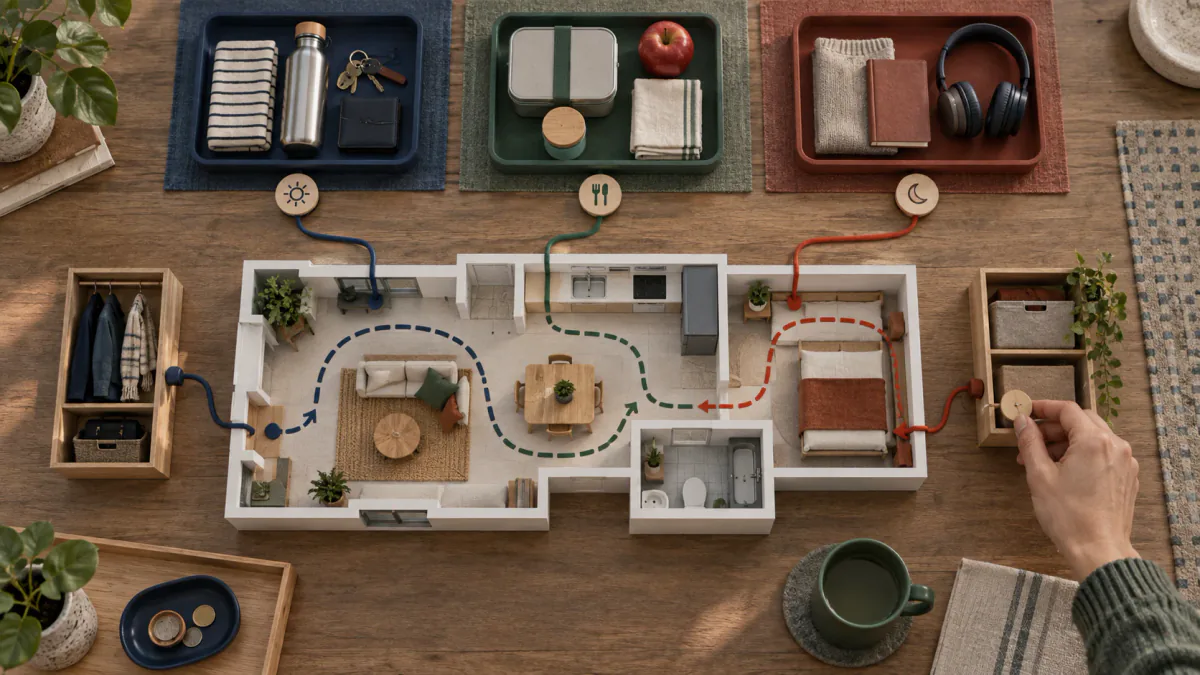
Trace what happens before, during and after that routine. For example, cooking starts with finding tools, uses a clear counter, and ends with tools washed and returned. Place objects near the part of the sequence where they are used. Keep only the categories that the location can support without blocking another task.
Set a recovery point
Define the minimum state that makes the next use possible: the counter has preparation space, the exit route is clear, or the desk holds a laptop. A short reset can restore that state. If it repeatedly requires a major sort, revisit volume and access rather than asking for more discipline.
This framework is an analytical aid for your own home, not a claim that one arrangement fits every household. A calm result is one that people can use and restore under ordinary conditions.
Identify the type of friction
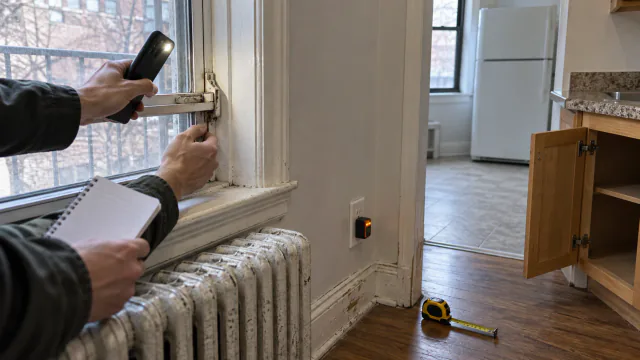
Walk through one ordinary routine and name each interruption. Sort it into access, volume, sequence, visibility or recovery. Access means the needed object is difficult to reach. Volume means the category exceeds its available space. Sequence means the object lacks a landing place between actions. Visibility means the system is hard to understand. Recovery means returning the room after use takes too many steps.
Do not diagnose the whole home at once. Choose the interruption that occurs most often or has the greatest consequence, then record where and when it happens. A clear diagnosis prevents buying storage for a sequence problem or decluttering when the real issue is access.
Respond to access and visibility problems
Move daily items close to the place of use and occasional items farther away. Keep frequently used categories within a comfortable reach appropriate to the household. Avoid deep stacks that hide one object behind another. A shallow tray, vertical divider or clearly bounded shelf may improve access without adding capacity.
Make labels and categories understandable to everyone who uses the space. Labels should describe the contents or action, not an abstract ideal. If an open shelf looks noisy, reduce the number of categories or place visually mixed necessities in closed storage while keeping the most-used group visible.
Respond to volume and sequence problems
For excess volume, set a physical limit and choose what best supports current routines. Do not move overflow into another active zone. For a sequence problem, add a controlled landing point: an inbox for current mail, a tray for keys or a portable work kit. Give that landing point a clearing cue so it does not become permanent storage.
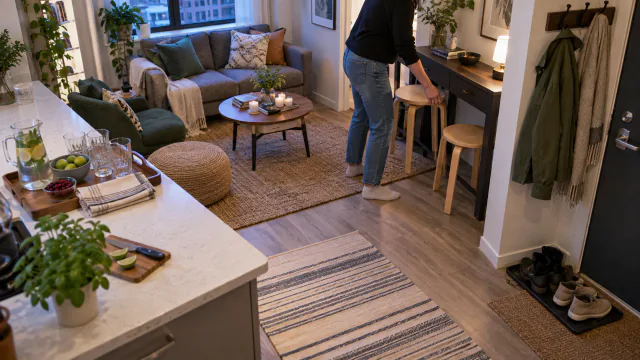
Observe where objects are naturally placed before selecting the location. A key hook across the room may look tidy but lose to the table beside the door. Place the return point along the route, then test whether it can be used while carrying the things normally in hand.
Design for recovery after a busy day
Count the actions required to reset the room. Reduce unnecessary lids, nested containers and distant return points for high-frequency items. Group supplies for activities that must be cleared, such as work or crafts, into portable kits. The goal is to restore function in a few obvious actions rather than maintain a permanently staged appearance.
Choose a cue connected to an existing routine: clear the dining table after the evening meal, return the work kit before closing the laptop or empty the entry tray on a set day. Add a stopping point so a short reset does not expand into an exhausting whole-home project.
Review the system with evidence
After a week, repeat the same routine and count interruptions, misplaced objects and reset actions. Ask whether the change solved the original friction or moved it. Keep what reduces effort without blocking another person, revise what almost works and remove additions that require constant correction.
A calm, organized home is not defined by empty surfaces alone. It is one where important routes remain clear, daily objects have understandable homes and ordinary disorder can be recovered without a major project. Record the successful capacity limits and reset cue so other household members can follow them. Apply the framework to the next area only after the first change remains stable.