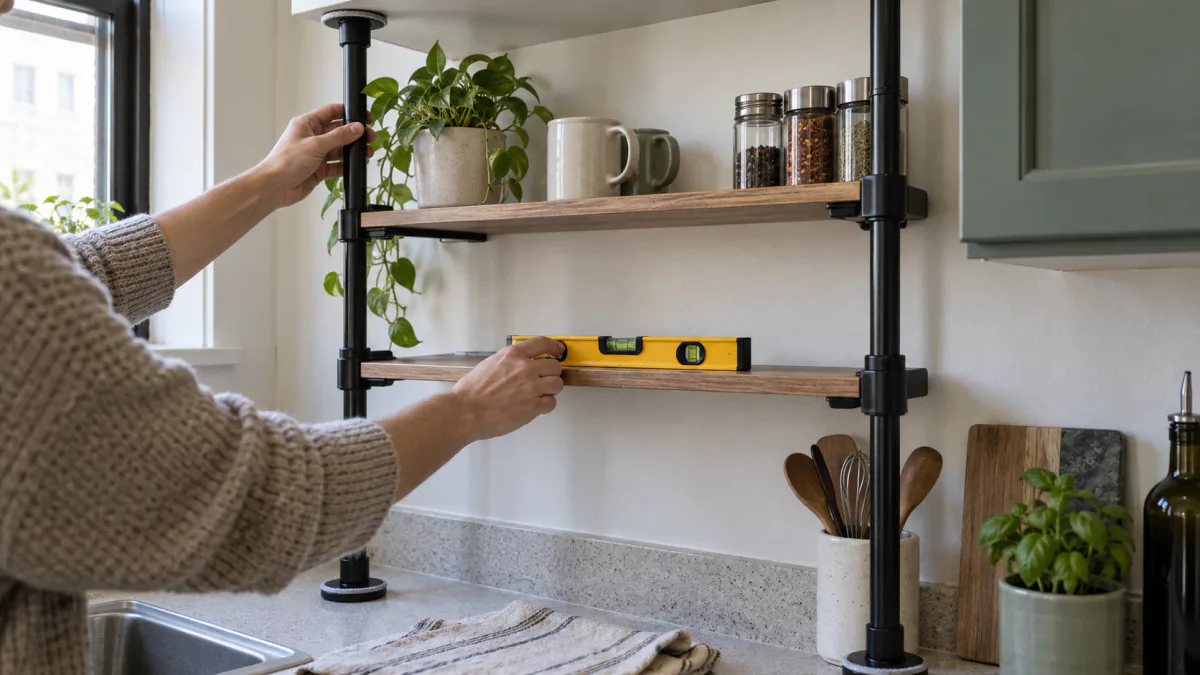
Confirm the installation boundary
Read the lease and building rules before planning a wall shelf. “Removable” hardware can still damage paint, tile or plaster, and adhesives have material and load limits. If drilling is not permitted or the wall construction is unknown, choose a freestanding organizer that does not block work space, appliance ventilation or the walking route.
Define the objects and load
List what the shelf would hold and how often each item is retrieved. Weigh or use manufacturer specifications for the intended load, and include the shelf itself. Keep heavy or breakable objects away from unstable placements. Never rely on a generic online weight claim when the actual wall, fastener and product instructions differ.
Mock up the footprint
Mark the shelf's proposed width and depth with removable tape. Open nearby cabinets and appliances; reach the preparation surface; check whether a person could strike the shelf while working. Avoid heat, moisture and splash zones unsuitable for the product material. A shelf that steals the only usable counter area may not solve a storage problem.
Install according to the actual system
If permission, wall condition, hardware and load limits are all clear, follow the specific manufacturer's instructions and use appropriate help where needed. Do not substitute a general blog sequence for installation directions. Afterward, load the shelf conservatively and check it periodically. If any prerequisite remains uncertain, stop the wall project and use a lower-risk storage location.
Define the shelf's single job
Name the items it must hold and why their current location fails. A shelf for daily mugs has different depth, access and load needs from one displaying light containers. Count the items, measure the largest one and decide whether the shelf is storage, a landing surface or display. Avoid combining all three jobs in a small footprint.
Try the proposed location with a taped outline. Open cabinet and appliance doors, prepare a normal meal and check the view from the main route. The shelf should not reduce a useful work surface, create a head-level obstruction or crowd a control, vent or heat source.
Check permission and product requirements
Read the lease and obtain any required written permission before drilling or altering finishes. Do not assume an adhesive product is harmless or suitable for a loaded shelf. Follow the shelf manufacturer's surface, hardware, installation and load instructions, and account for the wall construction.
If secure attachment cannot be confirmed, choose a freestanding insert, an existing cabinet reassignment or another reversible solution designed for the intended load. “Renter-friendly” should describe a verified installation and removal plan, not merely packaging language.
Plan clearance, retrieval and cleaning
Measure the objects at their widest point and include room for a hand to lift them safely. Keep heavier items lower and avoid storing breakables where they can be struck during cooking. Leave enough space to wipe the shelf and wall without unloading a complicated arrangement.
Place the most-used item where it can be removed without shifting another. Test the motion with the kitchen in use. If someone must lean across a hot or wet zone, relocate the shelf even if the composition looks attractive.
Make a prototype before installation
Use a cardboard box or stable existing surface at a comparable height to test the category for several days. Record whether the items return there, whether the counter becomes clearer and whether the new position interrupts another routine. The prototype also reveals whether the planned shelf is unnecessarily large.
After the trial, confirm measurements and purchase only the format that meets the identified job. Retain instructions, hardware and permission records. Photograph the original wall condition if appropriate for the rental record.
Set a capacity and review point
Leave open space around the category and do not exceed the product's stated limits. Review the shelf after installation and periodically thereafter for movement, damage or items added outside its purpose. Stop using it if attachment or wall condition changes.
The project succeeds when the shelf makes one kitchen action easier, remains clear of appliances and routes, can be cleaned, and has a documented removal plan. If it mainly creates another display to maintain, return to the cabinet or counter problem and choose a smaller intervention.