Define the storage job before the product
Write down the objects that currently lack a usable home. Group them by where they are used, how often they are retrieved and whether they need protection from dust or moisture. Edit items you no longer intend to keep before measuring a container: a larger box cannot make an unnecessary category useful.
Measure the largest object in each group and the opening it must pass through. Record the shelf depth, door swing, under-bed clearance or floor footprint available. The product's outer dimensions matter as much as its stated capacity. Leave enough room to reach the contents without shifting another stack first.
Compare formats by the way you retrieve things
| Format | Best use | Reason to skip it |
|---|---|---|
| Open bin | Frequent, lightweight items on a reachable shelf | Dust or visible clutter would make the area harder to maintain |
| Drawer unit | Small categories on a low or mid-height shelf | The drawer cannot open fully in the available aisle |
| Lidded box | Occasional items that need a closed container | Daily access would require lifting a stack or lid repeatedly |
| Freestanding shelf | Several categories that need separate levels | It narrows a route or cannot be stabilized appropriately |
This is a selection method, not a claim that a particular brand or material has been tested. Check product dimensions, load limits, cleaning instructions and return terms from the current seller or manufacturer before purchasing.
Choose the first purchase for a measured problem
If small daily objects disappear at the back of a low shelf, a shallow drawer or divided tray is a better first trial than another deep box. If seasonal textiles already have a clear category but collect dust, one correctly sized lidded container may help. If several categories are piled on the floor, first check whether an existing shelf can be reassigned; only consider a freestanding unit after marking its footprint and verifying that the route still works.
Buy nothing when the problem is excess inventory, an unclear category, or a location too far from where the object is used. A product earns a place only if the intended objects fit, retrieval is simpler, and the new footprint does not create another obstacle.
Count the management cost
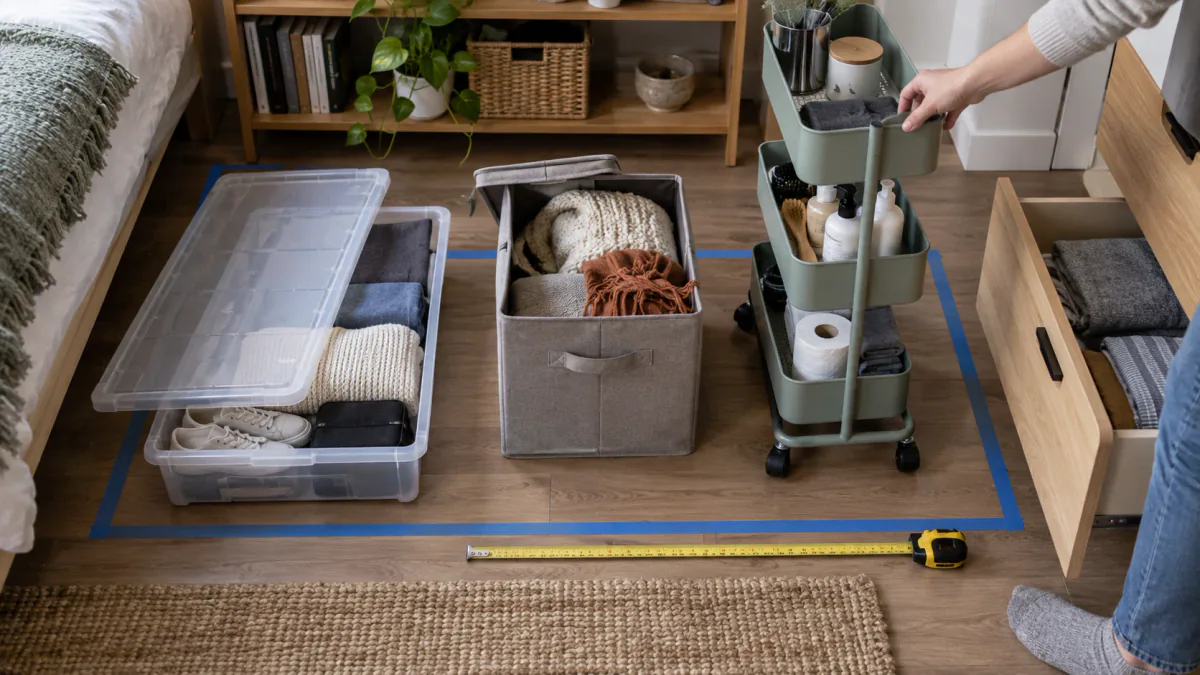
A storage unit uses more than purchase money. It occupies floor or wall space, can complicate cleaning, and may require a person to move one container to reach another. Make a cardboard outline of its footprint and rehearse the retrieval motion where the product would go. If the outline blocks the door or walking route, the extra capacity is a poor trade.
Try one unit before buying a matching set. Keep the packaging until you confirm that the intended objects fit and can be returned easily. A failed first unit is useful information; duplicating it across the room makes the mistake more expensive.
Check stability and installation
For furniture with doors, drawers or shelves, consider tip-over risk as well as storage volume. The U.S. Consumer Product Safety Commission's Anchor It campaign advises anchoring such furniture to the wall. Follow the manufacturer's instructions and use hardware suited to the wall and furniture; renters should check lease rules before installation. If safe anchoring is not possible, reconsider the product rather than treating a heavy lower shelf as a substitute.
The useful purchase is the smallest format that solves a repeated retrieval problem without creating a new access or safety problem. If existing shelves and a clearer category boundary already do that job, buying nothing is a valid result.
Audit the category before shopping
Empty only the category the product is supposed to hold, not the whole apartment. Count what is used weekly, what is seasonal and what no longer earns space. Measure the largest item, the total usable shelf or floor area and every door or drawer opening along the route. A container that fits the room but cannot pass the closet opening is not a viable option.
Write the failure in operational terms: stacked pans hide the daily pan, shoes interrupt the entry route, or cleaning tools fall when one is removed. Then define a successful result that can be tested. “Looks organized” is subjective; “daily pan can be removed without moving another pan” guides the product format.
Compare lifetime effort, not only purchase price
Include delivery, assembly, required hardware, maintenance, replacement parts and eventual disposal or moving. A low-cost shelf that needs tools, wall repair and a vehicle at move-out may carry more total effort than a smaller freestanding option. A collapsible product may justify its price when it stores flat between homes, but only if its joints and capacity suit the load.
Check return conditions before opening or assembling a product, and retain the measurements used in the decision. Do not assume a product photograph demonstrates stability or load capacity. Follow the manufacturer's instructions and confirm that the rental permits any attachment.
Run a no-purchase prototype
Use a cardboard box, existing tray or taped floor outline to represent the proposed footprint. Load it with safe stand-ins and complete the normal routine for several days. Test retrieval, cleaning around it, nearby door movement and whether another household member can understand the category.
If the prototype becomes an overflow bin, the category or capacity rule needs work before a product is selected. If the routine improves, record the exact internal dimensions and access style that mattered. Buy the simplest format that preserves those properties rather than the option with the most compartments.